
Dental injuries: what to do after an accident?
Teeth can be injured by falls, accidents or sport. Sometimes the injury is obvious, such as a broken piece of tooth or a tooth moved out of place, and sometimes no obvious damage shows even though the nerve or the tissues around the root have been affected.
Acting quickly after an injury can make an important difference, especially if a permanent tooth has come completely out of its place.
The recommendations issued by the American Association of Endodontists (AAE) in 2026 explain that treatment differs according to the type of injury, the condition of the root and whether the tooth has finished developing, and that follow-up is an essential part of care after accidents.
What to do if the tooth comes completely out?
This injury is called tooth avulsion.
First, it is essential to know whether the tooth is permanent or primary (baby), because the way to deal with it differs.
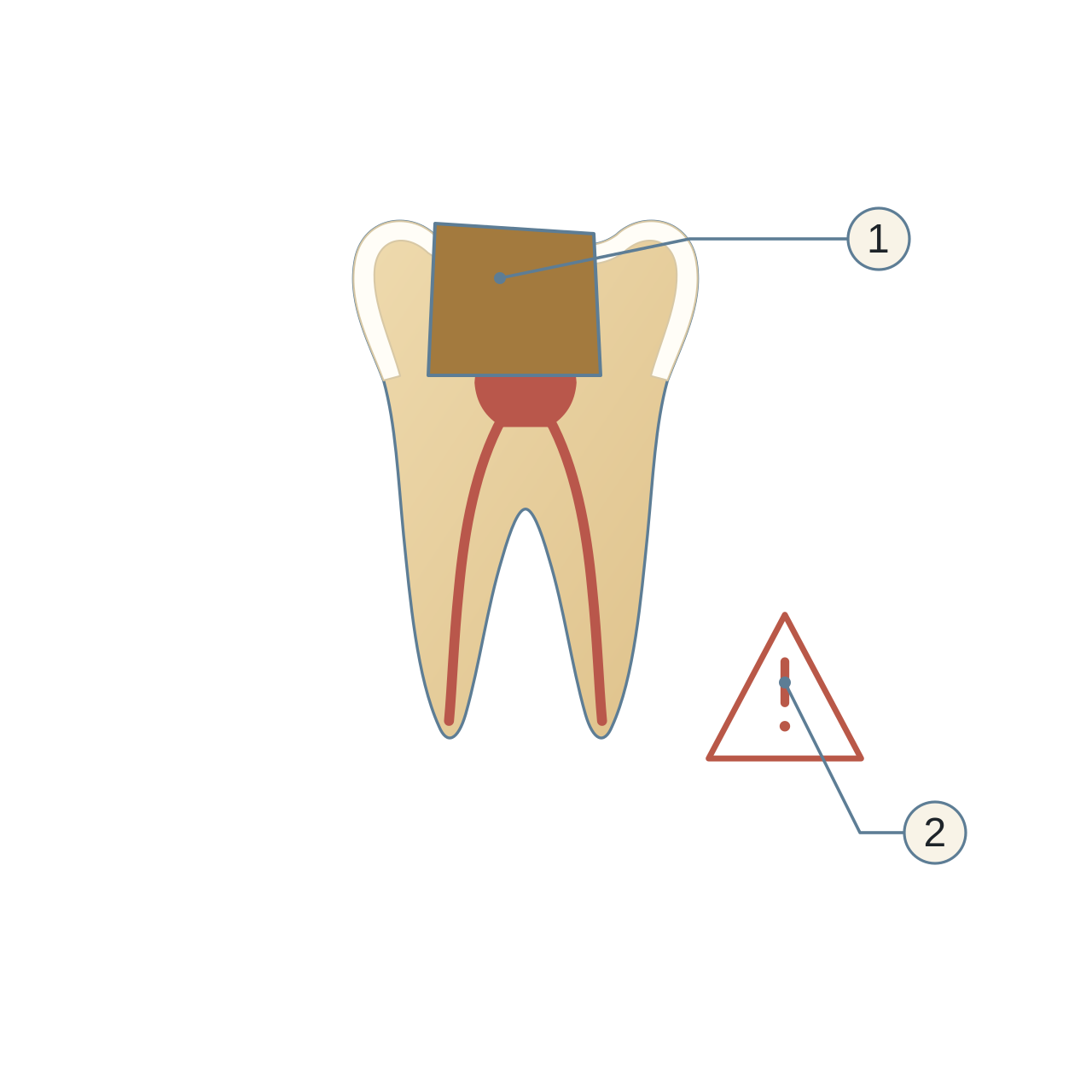
- Tooth crown
The highlighted upper part of the tooth.
- Urgent assessment
Read the accompanying injury instructions.
If the tooth is permanent
- Hold the tooth by the crown only: the white visible part of the tooth, and avoid touching the root.
- If it is dirty: rinse it gently with milk or saline. If these are not available, it can be rinsed with water for a few seconds, without rubbing the root or using any cleaning agents.
- Try to put it back in place immediately if you are sure it is a permanent tooth, the injured person is conscious and the tooth can be replaced safely. Insert it gently without using force.
- Hold the tooth gently in place: biting on a clean piece of gauze can help hold it temporarily.
- If it cannot be put back: place it immediately in milk or a solution made for storing teeth, such as Hank's Balanced Salt Solution (HBSS). Saline can be used if neither is available.
- Go to the dentist immediately: do not wait for the pain to settle, and do not put the assessment off until the next day.
Do not let the tooth dry out, do not wrap it in a dry tissue, and do not rub its root.
Even if reaching the doctor is delayed, do not assume that trying to save the tooth has become impossible; the clinical assessment decides the available options.
If the tooth is primary
Do not try to replant a knocked-out primary tooth.
Trying to put it back may harm the permanent tooth developing beneath it, so you should see a dentist to assess the injury and make sure the surrounding tissues and teeth are sound.
If you are not sure whether the tooth is permanent or primary, do not try to put it back yourself, and ask for an urgent assessment.
What if part of the tooth breaks off?
The fracture may be limited to the enamel, or reach the dentine or the pulp of the tooth, and in some cases it extends into the root.
If you find the broken piece, keep it in milk or saline and bring it with you to the doctor; it may be possible to reattach it in some cases.
Treatment varies with the location and depth of the fracture, and may include restoring the tooth, a treatment that preserves the vitality of the pulp, or root canal treatment when the case calls for it.
Can an exposed dental pulp be preserved after a tooth fracture?
Yes, in certain cases.
Exposure of the pulp after an injury does not necessarily mean the nerve must be removed completely. It may be possible to preserve its vitality through direct pulp capping or by partial pulpotomy.
The 2026 AAE recommendations stress the importance of these options, especially for immature permanent teeth, and they may also be used in selected cases of fully developed teeth.
The suitable treatment is decided according to the condition of the pulp, the nature of the fracture and whether the tooth can be restored.
What if the tooth moves out of place without coming out completely?
An impact may increase the mobility of the tooth, move it forwards or sideways, or push it into the bone.
These cases are known as luxation injuries.
Do not try to push the tooth back into place by force or move it repeatedly. See a dentist urgently to determine the type of injury and whether the tooth needs repositioning or splinting.
How are dental injuries treated?
Treatment varies with the type and severity of the injury, the stage of root development, and the condition of the pulp and surrounding tissues.
1. Repositioning and splinting the tooth (Repositioning & Splinting)
Some teeth that have moved out of place may need to be returned to their natural position and temporarily held with a dental splint.
The doctor decides whether splinting is needed and for how long, according to the type of injury.
2. Restoring fractured teeth (Dental Fracture Restoration)
The broken piece may be reattached when suitable, or the tooth may be restored with restorative materials depending on the extent of the damage.
Fractures that extend into the root may need additional procedures and an assessment of whether the tooth can be kept.
3. Preserving the vitality of the pulp (nerve) (Vital Pulp Therapy)
In some cases of injury to the pulp (nerve) or its exposure, vital pulp therapies can be used to preserve the vitality of the tooth, such as pulp capping or partial pulpotomy.
These procedures are especially important in immature permanent teeth, since they may allow the root to continue developing.
4. Root canal treatment after injury (Root Canal Treatment)
Not every tooth that is injured needs a root canal.
The response of a tooth to pulp sensibility tests (tests of the pulp’s response to cold or electrical stimulation) may be temporarily reduced after trauma, so a single test result, or a change in the colour of the tooth alone, is not enough to diagnose pulp necrosis (death of the pulp tissue).
The decision on root canal treatment depends on the type of injury, whether the tooth has finished developing, the clinical and radiographic examination, and what appears during follow-up.
In fully developed permanent teeth that came completely out of place and were replanted: the 2026 AAE guidelines usually recommend starting root canal treatment within 7 to 14 days after replantation, to reduce the risk of infection-related complications.
Some other severe injuries, such as intrusion of a fully developed permanent tooth into the bone (Intrusive Luxation), may also require starting root canal treatment early according to a protocol set by the doctor.
In immature permanent teeth: there may be an opportunity for blood supply to return to the pulp, so root canal treatment is not started automatically in all cases; instead the clinical and radiographic signs are monitored and intervention is made when indicated.
5. Treating teeth with immature roots
If an immature permanent tooth loses pulp vitality after an injury, the options may include:
- Creating an apical barrier in an immature permanent tooth with a necrotic pulp (apexification).
- Regenerative endodontic procedures (Regenerative Endodontic Procedures, REPs).
The suitable treatment is chosen after assessing the condition of the root and surrounding tissues and whether the procedure can be applied.
6. Managing root resorption
Root resorption may appear after some injuries, and it is a complication that needs attention during follow-up.
If infection-related external root resorption appears, the tooth may need early treatment to control the infection and limit the progress of the problem.
Why do teeth need follow-up after an injury?
A tooth may look normal after the accident or after initial treatment, but some complications appear only after weeks or months.
For this reason the 2026 AAE guidelines stress the importance of clinical and radiographic follow-up to monitor pulp vitality and tissue healing, and to detect early inflammation, root resorption or fusion of the root to the bone (Ankylosis).
Reviews may begin within the first weeks, then after several months, and in some types of injury they may continue yearly for at least five years.
Follow-up timing varies with the nature of the injury and the condition of the tooth, and there is no single schedule that suits all patients.
Can the tooth be kept after a severe injury?
In some cases the tooth can be kept despite the severity of the injury, but the result is affected by several factors, including the type of injury, how quickly treatment is given, whether the root has completed development, the condition of the supporting tissues, and whether complications appear later.
So the decision begins with examining the case and identifying suitable options, giving priority to keeping the natural tooth when that is possible.
When should you see the doctor?
You are advised to see a dentist after any injury that affects the teeth or the tissues around them, even if it is not accompanied by severe pain or an obvious fracture.
If a serious injury to the head, face or jaw is suspected, or there is loss of consciousness, heavy bleeding or difficulty breathing, emergency medical care must be sought immediately.
Have you injured one of your teeth?
You can contact the clinic to assess the injury or its complications and discuss suitable treatment options.
If the injury is recent and needs urgent intervention, do not delay care to wait for a routine appointment; ask the communication and bookings team for an urgent emergency appointment.
References
- Primary reference: Sigurdsson A, Blicher B, Miller AJ, et al. Recommended Guidelines of the American Association of Endodontists for the Treatment of Traumatic Dental Injuries. Journal of Endodontics. 2026;52(8):1237–1253.Issued by the American Association of Endodontists (AAE).Read the full original article: https://www.sciencedirect.com/science/article/pii/S0099239926001925Permanent scientific link (DOI): https://doi.org/10.1016/j.joen.2026.04.002
- Additional reference for primary teeth: International Association of Dental Traumatology (IADT). Guidelines for the Management of Traumatic Dental Injuries: Injuries in the Primary Dentition. Dental Traumatology. 2020.Permanent scientific link (DOI): https://doi.org/10.1111/edt.12576
Related reading


Medical notice: the information here is for general health education and is not a substitute for an examination and assessment by a dentist. If you notice any symptoms or changes in your teeth or gums, even if they seem minor, do not ignore them; consult a dentist to assess them and decide whether they need treatment.