
What is root canal retreatment?
A tooth that has already had root canal treatment may need retreatment if the problem persists or a new infection appears around the roots. In some cases the problem appears years after the first treatment, even when the patient feels no pain.
Endodontic retreatment aims to reach the root canals again, remove the previous root filling material, clean the canals and refill them, in order to treat the cause of the problem and keep the tooth where possible.
There may still be a chance to save your natural tooth.
Why might a tooth need retreatment?
There are several reasons, and a tooth needing retreatment does not necessarily mean the previous treatment was done wrongly.
Possible reasons include:
- An extra canal that was not found or treated before (Missed Canal), such as the second mesiobuccal canal (MB2) in some maxillary molars.
- Narrow, calcified or severely curved canals that made complete cleaning difficult.
- Persistent infection inside the canals, or a new infection.
- A delayed final restoration, or leakage around the filling or crown.
- New decay or a fracture that lets bacteria reach the inside of the tooth.
- Obstacles inside the canals, such as a broken instrument or deviation from the canal path.
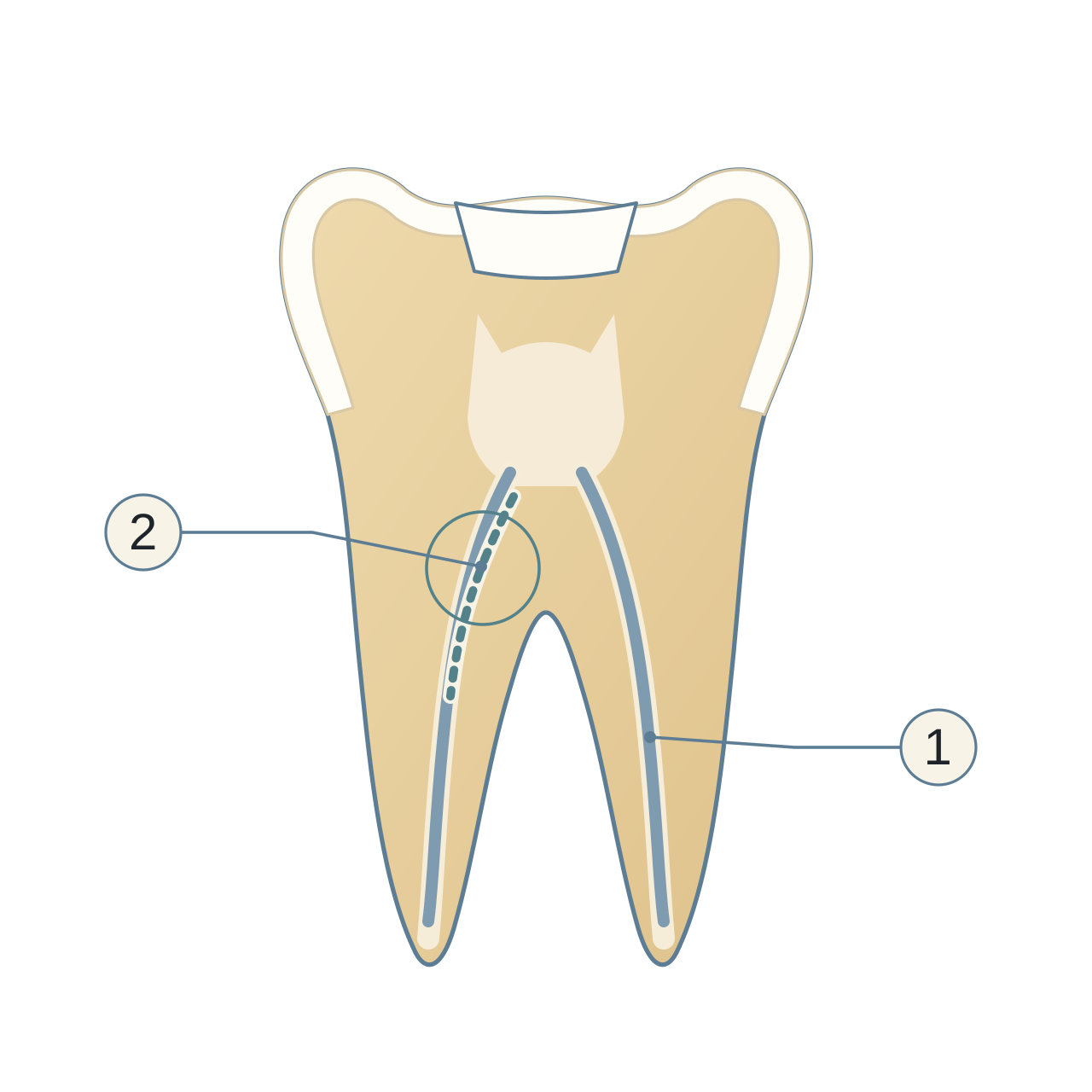
- Previous root canal filling
One part of assessing the tooth.
- Area for assessment
An illustration, not the cause of every retreatment.
In some cases a dark area around the end of the root may remain visible on X-rays during the healing period, without necessarily meaning the treatment has failed. So the decision to retreat is not made from the X-ray image alone, and the doctor's assessment is essential.
How do I assess the tooth before retreatment?
I start by reviewing the symptoms and the history of previous treatment, then carry out a clinical examination and assess the X-rays.
I look for the cause of the problem and assess the roots, restorations and tissues around the tooth. I may use three-dimensional imaging (CBCT) when it helps answer a specific diagnostic question.
I also assess whether the tooth can be kept and restored after treatment, and discuss the available alternatives before deciding, including with other specialties if needed.
How is root canal retreatment done?
The treatment steps vary with the condition of the tooth, and may include:
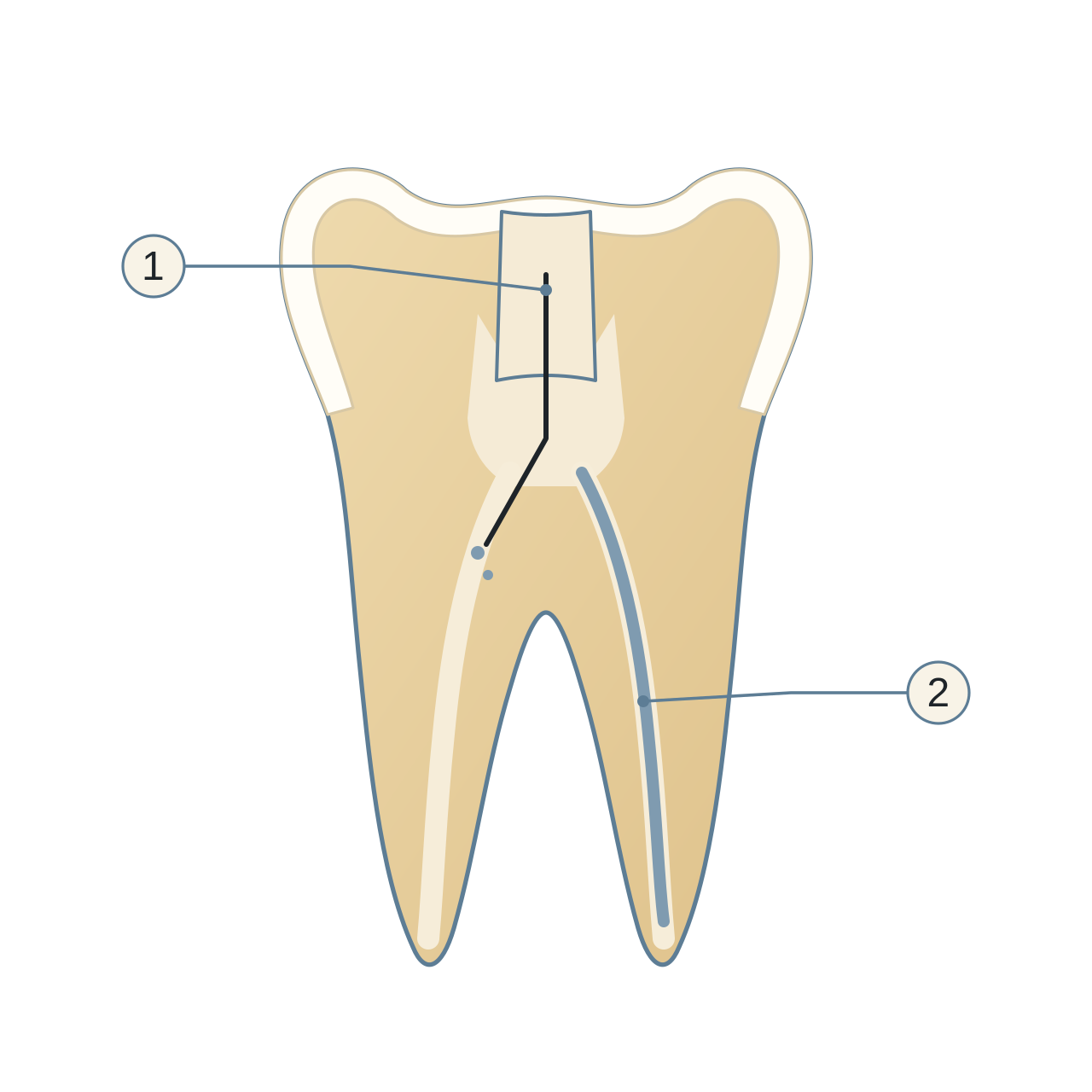
- Access opening
Provides access to previous filling materials.
- Previous filling materials
Removed as part of the retreatment plan.
- Reaching the root canals: through the existing restoration or after removing part of it; some cases may require removing the crown or post.
- Removing the old filling: to reach the canals, reassess and clean them.
- Finding untreated canals: including extra canals or ones that could not be reached before.
- Dealing with obstacles: such as separated instruments, calcifications or deviations inside the canals, when intervention is possible and safe.
- Re-cleaning and shaping the canals: using suitable instruments and cleaning solutions.
- Refilling and sealing the canals: after preparation is complete and the case is suitable for filling.
- Completing the restoration of the tooth: in coordination with the treating dentist when needed, to protect the tooth and restore its function.
Retreatment may need one visit or more, depending on the number of canals, their complexity and the nature of the problem.
Can a separated instrument or a post inside the root be removed?
In some cases, removing the separated instrument (Separated Instrument Retrieval) or bypassing it (Instrument Bypass) is part of the retreatment plan. It may also be necessary to remove a post inside the root (Post Removal), if there is one, to reach the canals.
But removal is not always the best option; intervention can sometimes weaken the root or increase the chance of complications. So the procedure is decided after assessing the position of the obstacle, the condition of the root and whether bypassing or removing it is needed.
What if retreatment is not possible?
Retreatment from inside the tooth is not the right option for every case.
Endodontic microsurgery may be an option in some cases where the cause of the problem cannot be reached from inside the tooth, or where nonsurgical retreatment is not suitable.
In other cases, such as some root fractures or teeth that cannot be restored, extraction may be the most suitable option.
I discuss these possibilities with the patient after assessing the case, without assuming that retreatment is the only solution.
What happens after retreatment?
The patient may feel some discomfort during the first days. Recovery depends on the nature of the case and the degree of inflammation present before treatment.
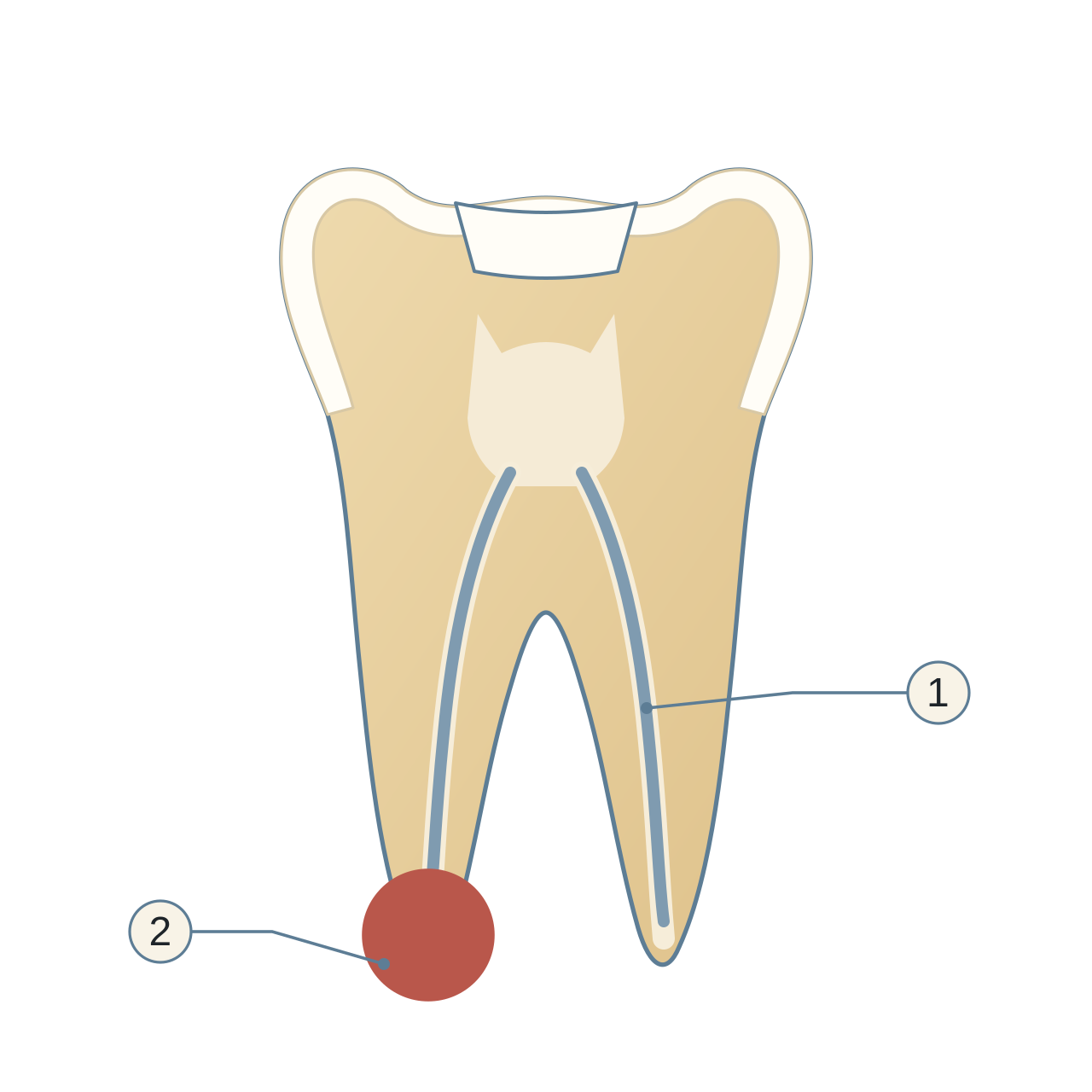
- Refilled root canals
After cleaning and shaping again.
- Follow-up area
Assessed during follow-up.
Also, the disappearance of symptoms does not necessarily mean the tissues around the root have fully healed; healing may take longer and needs clinical and radiographic follow-up.
Follow-up appointments are set according to the case and the treatment results.
Regular follow-up of root canal treatment carried out in the clinic is provided at no additional charge.
Frequently Asked Questions
Is retreatment harder than the first treatment?
It can be more complex because of previous fillings, posts, canals that were not found, or obstacles inside the roots. The degree of difficulty differs from one tooth to another.
Can a root canal be retreated without removing the crown?
Yes. In some cases the canals can be reached through the existing crown, while other cases require removing it. The decision depends on the condition of the crown and the tooth and whether the canals can be reached safely.
Does retreatment guarantee the tooth will be kept?
No treatment's outcome can be guaranteed. The chance of keeping the tooth depends on the cause of the problem, the condition of the roots and surrounding tissues, and whether the tooth can be restored after treatment. Each case is assessed individually by the treating doctor.
Does a tooth need retreatment if inflammation shows on the X-ray but there is no pain?
Not necessarily. I first need to assess the image, the symptoms and the treatment history, and compare with previous X-rays if available, to determine whether the area is healing or points to an ongoing problem that needs intervention.
Is retreatment likely to work?
It depends on the cause and the condition of the tooth. I will give you an honest assessment after the examination and imaging.
Assessing your case
If you have had a root canal and your dentist has told you there is persistent inflammation, or you have new symptoms in the treated tooth, you can book an appointment to assess the case and discuss suitable options.
To book or ask a question: contact me on WhatsApp or by phone.
References
Related reading


Medical notice: the information here is for general health education and is not a substitute for an examination and assessment by a dentist. If you notice any symptoms or changes in your teeth or gums, even if they seem minor, do not ignore them; consult a dentist to assess them and decide whether they need treatment.